



In hospitality environments, every detail of the guest experience matters—including the restroom. While lobbies, guestrooms, and dining areas often receive the most design attention, restrooms remain among the most frequently used spaces in hotels, resorts, and conference facilities. The condition and design of these high-traffic spaces can influence how guests perceive the entire property.
Bathrooms, once simply seen as an institutional necessity, have become important markers of guest trust and operational efficiency.
2026 findings from the Healthy Handwashing Survey conducted by Bradley Company highlight how strongly restroom conditions shape public perception. The nationwide survey found that 86 percent of Americans say the quality of a business’s restrooms reflects the quality of its products or services. In addition, 84 percent form a negative impression when restrooms are dirty or poorly maintained, while 70 percent are more likely to return—and 60 percent will spend more money—at facilities with clean, well-maintained restrooms.
For hospitality operators focused on guest satisfaction, these findings reinforce the importance of thoughtful restroom design. Cleanliness, privacy, touch-free functionality, and coordinated aesthetics all contribute to a restroom environment that supports hygiene and guest confidence.
Hygiene Expectations Continue to Influence Design
Handwashing awareness has remained high in recent years, particularly during flu and respiratory illness seasons. The survey shows that 81 percent of Americans wash their hands more thoroughly and more frequently when concerned about illness, while many remain cautious about shared surfaces.
This concern is evident in restroom behavior. Approximately 65 percent of respondents report using a paper towel or clothing to avoid touching faucets, flushers, or door handles, and 42 percent operate toilet flushers using their foot. These habits indicate that many users still try to minimize contact with restroom surfaces.
Such germ-avoidant behaviors, along with high expectations for cleanliness, are driving increased adoption of touchless technology and hygienic materials.
Touchless Fixtures Improve Hygiene & Guest Confidence
 Touch-free fixtures such as sensor-activated faucets, soap dispensers, flush valves, and hand dryers have become a standard feature of modern restroom design. Nearly 80 percent of Americans say touchless fixtures are important in public restrooms. By eliminating the need to touch shared surfaces, these systems help reduce germ transfer and reinforce the perception of a cleaner environment.
Many hotels are also adopting integrated handwashing fixtures that combine soap, water, and hand drying in a single component at the sink. These systems simplify the handwashing process while helping contain water inside the basin area. Keeping water in the sink, rather than dripping on the floor, improves safety and reduces slip hazards in busy hospitality settings.
Touchless fixtures can also support operational efficiency. With fewer manual components to clean and disinfect, housekeeping teams can maintain hygiene standards more efficiently.
Seamless Materials Support Cleanability & Longevity
Material selection also plays an important role in restroom hygiene, maintenance, and sustainability. GREENGUARD-GOLD-certified low-VOC washbasins constructed from seamless solid surface or natural quartz materials offer several advantages in hospitality environments where durability and cleanliness are priorities.
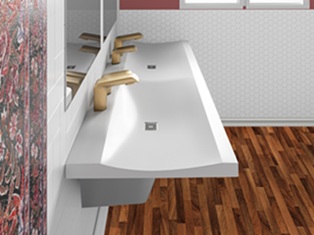 Because these materials are cast as one piece rather than assembled from multiple components, they eliminate seams and joints where dirt and bacteria can accumulate. Smooth, nonporous surfaces make cleaning easier and help maintain a fresh appearance over time.
These materials also provide long service life. Their resistance to staining, chipping, and cracking allows them to withstand heavy use while maintaining their visual appeal. Many seamless materials can also be refinished or repaired rather than replaced, reducing material waste over the life of the building.
Cohesive Design Enhances the Guest Experience
Beyond functionality, aesthetics remain an important component of restroom design. Hospitality designers increasingly emphasize coordinated accessory collections in matching finishes that create a unified visual environment.
Accessories such as grab bars, towel dispensers, mirrors, shelves, and waste receptacles can carry a consistent style throughout the restroom. Clean lines, smooth surfaces, and contemporary finishes contribute to a modern aesthetic that complements the overall design of the property.
These cohesive design approaches reinforce the perception of a well-maintained facility. When accessories and fixtures appear coordinated and thoughtfully integrated, the restroom environment feels more polished and intentional.
Privacy is Becoming a Higher Priority
 Privacy has become a growing focus in restroom design. Survey findings show that users prefer stalls with fewer gaps and greater enclosure. Nearly 70 percent of Americans think restroom stalls should provide more coverage. Specifically, 52 percent would like the gaps around stall doors eliminated, and 43 percent would like occupancy indicators.
Many hospitality properties are adopting more enclosed partition systems that reduce visible gaps around doors and panels. Floor-to-ceiling partitions or European-style stall designs can provide greater privacy while maintaining a sleek appearance.
User-focused details such as quiet slow-close hinges and LED occupancy sensors built into the cubicle system also help improve traffic flow in high-traffic areas such as conference centers, banquet spaces, and event venues.
Restrooms as a Brand Touchpoint
In hospitality settings, every space contributes to a guest’s perception of a property—including the restroom. Clean, modern, and well-maintained restrooms signal attention to detail and reinforce a hotel’s standards of quality.
Survey findings support this connection: most Americans say they expect businesses with high-quality products or services to have equally well-maintained restrooms. Thoughtfully designed restrooms with coordinated fixtures, contemporary finishes, and easy-to-use features help strengthen guest confidence and support a positive overall impression.
For hotels and resorts, restroom design is more than functional—it is an extension of the property’s brand and commitment to guest experience.
About the Author
By Kris Alderson, MBA, LEED AP, is Senior Marketing Manager for Bradley Company, the 100-year-old global manufacturer of commercial plumbing fixtures, washroom accessories, emergency safety fixtures and electric tankless water heaters. Bradley is now a division of Watts Water Technologies.