



Even with all the amenities today’s luxury travelers enjoy—state-of-the-art spas and fitness centers, 5-star restaurants, and high-end retail boutiques—getting a good night’s sleep is the true test of a hotel stay; the core of the luxury hospitality experience. Guests seek out properties that don’t just offer a comfortable bed but deliver a holistic, restorative environment. Luxury hoteliers are recognizing the opportunity to build a competitive advantage around this “sleep tourism.”
Smart Lighting and Shading Solutions—Part of a Redefined Guestroom Toolkit
Smart lighting and shading, along with HVAC, typically have the most direct influence on a guest’s sleep. When room lighting and shading systems are thoughtfully designed, guests are more likely to fall asleep faster, wake up more refreshed, and generally have a more comfortable stay. Sleep-forward brands are specifying lighting systems with a focus on intensity, color temperature, personalization, and ease of use.
The same attention applies to shading design. Sleep is affected by the consistency and quality of darkness, making near-total blackout performance essential for rest-forward design. Shades should offer blackout control (with <1 percent light leakage) and operate quietly to help ensure high-quality rest. Pursuing true blackout can be challenging and requires large overlaps or side channels—investments that will pay dividends when the positive reviews stack up. Together, lighting and shading systems create a room that shifts seamlessly throughout the day, supporting natural bodily rhythms and the goal of deep, uninterrupted sleep.
A New Generation of Guestroom Technology: Personal, Seamless, Sustainable

One of the most significant changes in hospitality technology over the past five years has been the shift toward systems that are intuitive and simple for the guest yet highly sophisticated behind the scenes. Oversized touch screens and complex interfaces may have been cutting-edge a decade ago, but guests are now looking for the familiarity of control through apps on their own smartphone, or intuitive entry and bedside controls with clearly labeled buttons.
As technology improves, advanced features can take personalization even further. Systems may allow guests to choose preferred wake/sleep times, customize night-light levels or reading-light preferences, and save favorite scenes for future visits at checkout. This ability to personalize—yet reset reliably—gives guests a heightened sense of control, helps hotels maintain operational consistency, and provides an opportunity to make return visits feel a little like coming home.
Sustainability is also a core driver for hoteliers. Tunable LED lighting dramatically reduces energy consumption, and automated shades reduce HVAC loads by managing solar heat gain. Integrated sensors ensure that rooms are only lit when occupied, and air conditioning setpoints are adjusted to a higher level in unoccupied rooms. For balancing guest expectations with ESG commitments, lighting and shading controls have become a high-impact investment with a fast ROI.
Operational Ease: The Overlooked Advantage
Wellness-focused design doesn’t just help guests sleep better—it helps hotels operate more efficiently. Standardized scenes reduce room-to-room variability while automated sequences minimize guest confusion. Integrated controls support quicker diagnostics and minimize downtime. Maintenance plans for shade motors, keypads, and commissioning updates keep systems performing reliably over years of high-volume use. This operational clarity becomes especially valuable in luxury properties where consistency is a defining part of the brand.
A Real-World Example: The Ritz-Carlton, Mexico City
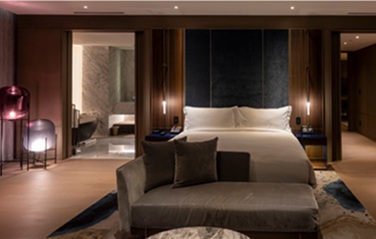
At The Ritz-Carlton, Mexico City, lighting, shading, and environmental control were approached as central elements of the guest experience, not utilitarian add-ons. Motorized shades provide near-total blackout for rest while revealing sweeping city views at the touch of a button. Scene-based controls give guests simple, elegant tools to shape their environment without complexity. “The welcome scenes are a bit theatrical — creating an appropriate contrast between darkness and light to make the rooms look really spectacular. The owners loved that guests would have the same welcome experience regardless of when they stayed at the hotel,” says Jose Cardona, Principal at Artec Studio, lighting designer on the project.
The result is a room that feels calm, intuitive, and quietly luxurious—a space where lighting and shading work in harmony to support rest, elevate mood, and express the hotel’s design vision.
Bringing Sophistication—and Sleep—to the Modern Guestroom
As wellness and sleep tourism continue influencing travel behavior, hotels have a unique opportunity to lead with environments that feel restorative from the moment a guest walks in. Thoughtful lighting design, advanced shading systems, and integrated controls are becoming the new language of luxury—quietly shaping atmosphere and comfort. When executed well, these systems don’t just help guests sleep better; they help hotels perform better, too—reducing energy use, streamlining operations, and reinforcing the brand’s commitment to exceptional, personalized hospitality. For luxury travelers seeking more than just a place to stay, they create something invaluable: a room that’s genuinely designed to care for them.
About the Author
Ana Maria Huertas Iragorri has been focused on the Hospitality technology space for almost 20 years, with vast experience in collaborating with Ownership Groups, Brands, and the Specification Community. With an Undergraduate Degree in International Relations and an MBA in International Business, Ana Maria is also a LEED AP. She is currently the Global Hospitality Sales Director at Lutron Electronics.