


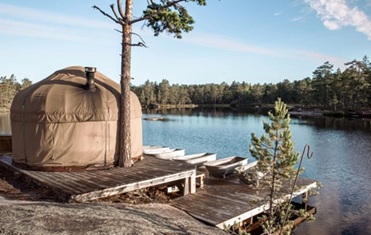
 NORWAY—Most hospitality runs on infrastructure you never think about until it fails—mains power, a water line, a road for the delivery van. We have none of it. The camp I manage sits seven kilometers from the nearest village, on an island in the Norwegian highlands with no road access. Guests park where the road ends and walk the last stretch on foot. Everything else crosses the water by boat.
I started as a guide at Norrøna Canvas Telemark in 2016 and have managed the camp since 2017. Over the last decade, I’ve come to believe that the operational discipline behind a remote, off-grid property holds lessons for the wider industry, especially as more guests look for stays in remote, hard-to-reach places.
When Every Supply Arrives by Boat
The camp opened in 2010, built for mountain bikers and designed to leave no trace. The accommodation sits on stilts along the rocky slopes, built so that if it were removed, the site would return to nature. It is run on solar power, wood and gas, with electricity in the shared areas so guests can charge a phone or laptop. The kitchen has no conventional heating and cooks over wood-fired stoves and grills.
Guests still eat well, sleep well and unwind in wood-fired saunas and outdoor baths after a day on the trails. The difference is that every comfort must be carried across the lake by boat before a guest ever sees it. Off-grid hospitality means meeting a high standard with none of the infrastructure most properties rely on and building the systems yourself when none exist.
The ‘Jack of All Trades’ reality
In a conventional hotel, you call a contractor when something breaks. Here, the nearest help is across the water and over the mountain, so we maintain almost everything ourselves, from the water supply to the heating. On a typical day I’ll guide a group on the trails myself for a few hours and still be the person troubleshooting a system back at camp. A manager in this setting can’t only be good at spreadsheets. You must understand every technical system on site and be able to fix it when it fails.
That shapes how we hire. We run with a core team of around eleven who live on site through the season—guides, chefs and maintenance staff—and scaled to sixteen people in total last year. The season runs from May to September, with the surrounding months going into setup, maintenance and planning. When everyone lives where they work and the supply line is a boat, versatility is the baseline requirement for everyone here.
What Guests Are Really Coming For
The biggest change I’ve seen is in what guests want from a stay. Increasingly, the reward they’re after is a sense of accomplishment rather than pampering. Watching someone who has never ridden an electric mountain bike come back to camp grinning, after clearing a technical section they were sure was beyond them, is the part of the work I never tire of. That feeling of mastery is becoming its own form of recovery, and remote destinations are well placed to provide it.
In the beginning, we hosted almost exclusively avid male mountain bikers. That has completely changed; now, we welcome everyone—from guests who simply want to relax in the outdoor bathtubs, to complete beginners eager to join our introductory trail biking courses.
Common Ground Around the Fire
A camp like this draws a mixed crowd, from company executives to serious cyclists. What strikes me most is how readily very different people connect around the same fire once the riding is done. One guest in his seventies told me, after a life spent traveling the world, that this was the most memorable thing he had experienced. What stayed with him wasn’t the furnishings; it was the day behind it. For an industry investing heavily in personalization, a strong setting and a shared experience can carry a lot of the weight on their own.
Sustainability Depends on Relationships
The environmental side of an off-grid build gets the attention, and we take it seriously, but the harder work is human. Operating in a remote area means a close, continuous dialogue with the landowners around us, built on years of trust rather than a single agreement. A wilderness operation only survives if the surrounding community wants it there. For any operator moving into remote or experiential hospitality, that relationship is the part I would treat as non-negotiable. The operators who work out how to deliver genuine comfort within real constraints—not despite them, but through them—are the ones I think will define where this category goes.