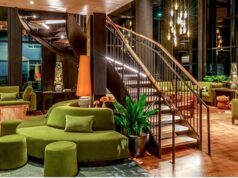



Rooftop bars, pool decks and high-rise terraces have become some of the most valuable real estate a hotel owns. They are also the hardest spots on the property to put an open-flame grill and stay within code. That code problem turns out to be one piece of a larger story. Fire risk, safety, sustainability and long-term operating cost are all pushing hospitality toward the same answer, and it is worth walking through why.
Section 308.1.4 of the International Fire Code prohibits open-flame cooking devices, including charcoal burners and gas grills, on combustible balconies or decks, or within 10 feet of combustible construction. Single- or two-family dwellings are exempt, but it applies to hotels (Group R-1 occupancies) and apartment buildings (R-2), with few exceptions: buildings, balconies and decks with automatic sprinkler protection or LP-gas devices with tanks holding roughly 2.5 pounds of water capacity or less. Neither exception is realistic for a hotel running a gas- or charcoal-grill program. Rooftop and pool deck amenities run into this constantly because of what surrounds them: parapet walls, cabana structures, wood decking, all combustible construction that triggers the clearance rule and can consume half the usable space an amenity was built around.
Modern electric grills are the easy solution to that problem. No open flame means virtually no fire risk near guests and staff, no combustion byproducts to vent, no propane tank storage and swap logistics. Electric grills can be placed where a gas grill legally cannot be installed, without sacrificing cooking performance. Some electric grills even offer indoor applications, offering even more versatility for guests. A resort clubhouse or common area kitchen can include built-in models with the same grilling advantages as an outdoor electric grill, provided the grill’s design offers a smoke-free cooking experience, and the product is UL-listed and fire-rated to meet NFPA requirements. This would allow guests to grill year-round, regardless of the weather, even in colder climates.
Advantages That a Gas Grill Cannot Match
Beyond the fire code, they also offer practical advantages that a gas grill cannot match. Many include a built-in automatic shut-off, an important safety feature in an amenity setting where staff cannot watch every guest at every moment. The best models heat up quickly and evenly, reaching 550 degrees for a genuine restaurant-quality sear without needing an open flame. Because the heat is controlled rather than open, there is nothing for a guest to fight with: no flare-ups, no smoke and a far shorter learning curve than propane or gas, which matters as most guests using a self-serve amenity grill are not experienced cooks.
There is a food-safety benefit as well. Cooking without an open flame avoids the carcinogen risk of charring food directly over a flame, making the food itself healthier for guests. For hotel staff, cleaning is easier too. Many electric grill grates wipe clean with a wet paper towel or can be removed and placed in a dishwasher. There’s no risk of accidental wire brush ingestion, no forceful scrubbing, and the grill stays in better, more appealing condition for guests.
For eco-conscious cooks, electric grills represent the most sustainable path to grilling because they eliminate direct fossil fuel combustion. Charcoal generates particulate soot, carbon monoxide and ash; propane depends on non-renewable fuel extraction and single-use tank shipping. Electric equipment produces none of that on-site, and its heating elements convert energy to heat with far less waste. While their total lifecycle impact depends partly on the regional power grid, electric grills hold a unique long-term advantage: as the grid increasingly integrates solar, wind and other clean energy sources, your grilling automatically becomes greener over time, a level of future-proof sustainability that gas and charcoal can never match.
It Comes Down to Cost
The question for many hotel property owners comes down to cost, and fire code is increasingly making that choice for them rather than leaving it optional. A single new outdoor outlet on a dedicated circuit runs roughly $250 to $900. A complete outdoor-kitchen electrical build, a 240-volt grill circuit, weatherproof equipment, GFCI protection, conduit, trenching and site restoration may run anywhere from $2,500 to $6,000 per location, before the cost of the grill itself. Rooftop decks, pool areas, long trench runs, and projects needing new electrical pedestals or protective bollards push costs higher. Whether any of that reads as cheap or expensive depends heavily on timing: a property still on paper can wire for electricity from the start, while one that has already runs gas lines to a rooftop or pool deck is looking at a retrofit rather than a straightforward spec decision. Local fire and electrical codes, plus insurer and fire marshal requirements, are worth confirming before procurement rather than after. But over time, the savings can be substantial in terms of damage, risk, fire and gas costs. For new properties, plans that include electrical before gas lines are drawn face a straightforward electrical spec decision and reduced costs from the start.
Fire code, guest and staff safety, and long-term operating cost are not separate arguments for electric grilling equipment in hospitality. They are the same argument told multiple ways: gas and open-flame equipment carry risks, physical and financial, that electric equipment does not introduce. The properties ahead of this are not waiting for a code inspector to force a decision. They are treating electric grills as the safer default for every rooftop and pool-deck amenity, from the blueprint stage onward.
About the Author
Danielle Owens is an Account Manager at Kenyon International, specializing in the hospitality and government markets. With nearly 10 years of experience in the hospitality industry, she brings a strong background in sales, business development and hospitality operations. At Kenyon, she works closely with hotel brands, ownership groups, developers, and procurement partners to identify cooking solutions that meet the evolving needs of hospitality environments. Kenyon International designs and manufactures premium electric grills and cooktops for residential, marine, RV, and hospitality applications. Proudly designed and assembled in Clinton, Conn., Kenyon is known for innovative, durable, and convenient cooking solutions that make high-performance cooking possible in more places.