



In case you missed it, this past week’s big news came out of Hilton’s headquarters with the unveiling of the company’s new Home2 Suites by Hilton Clean Energy Prototype, an optional, turnkey design concept geared to help owners lower operating costs, improve energy efficiency and reduce emissions while maintaining the guest experience Home2 Suites is known for.
The announcement was especially significant because Home2 Suites by Hilton has more than 900 open hotels with nearly 750 hotels in development. According to Hilton, Home2 Suites by Hilton, a mid-tier, all-suite, award-winning extended-stay hotel concept, is the hotel brand with the largest development pipeline in the U.S.
“It’s a great example of how we’re approaching sustainability at Hilton: focusing on practical, scalable solutions that support our owners, strengthen our business and help advance our Travel with Purpose strategy,” says Jean Garris Hand, VP | Global Head of Sustainability & Responsible Business at Hilton. (Don’t miss my interview with Jean Garris Hand later in this article.)
Hilton tracks, analyzes and reports the impact of Hilton’s portfolio of hotels through LightStay, an industry-leading environmental and community impact management platform.
First Zero Operational Emissions Prototype
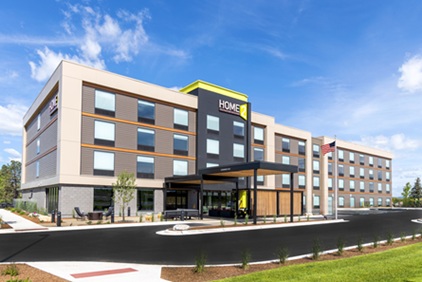 This is Hilton’s first zero operational emissions prototype. With U.S. hotel utility costs up 28 percent over the past five years according to AHLA, the prototype is designed to help owners manage that pressure through all-electric systems, renewable energy and a more efficient building envelope.
Modeling across 13 U.S. cities indicates the design could reduce annual energy costs by 18 to 40 percent, improve energy efficiency by 30 percent and reduce operational carbon emissions by approximately 440 metric tons. The prototype aligns with zero operational emissions building requirements established by the World Green Building Council.
According to Hilton, owners of the new Home2 Suites by Hilton Clean Energy Prototype can expect to see significant potential asset valuation increases—$670,000 in San Jose, Calif., $360,000 in Boston, and $320,000 in Atlanta are a few estimates.
Energy Procurement Program
Beyond the Home2 Suites Clean Energy Prototype, Hilton continues to explore additional ways to apply these solutions across different markets, operating environments and owner needs. For example, Hilton’s procurement arm, Hilton Supply Management, continues to expand its energy procurement program that helps hotels manage energy costs, improve budget predictability and evaluate renewable and lower-carbon energy options where available. In 2025, the program helped participating owners save approximately 17 percent on their energy costs and avoided more than 102,130 metric tons of CO₂ while supporting more sustainable operations and lower energy costs.
Since its inception, Home2 Suites was designed with reduction in environmental impact in mind. Examples include the use of carpet tile, energy efficient roofing materials, Energy Star-rated appliances, increased natural light and LED lighting, hydration stations, electric vehicle charging stations, recycling receptacles and saline pools. The brand has also introduced programs to reduce unnecessary plastic containers and packaging, such as providing reusable dishware in the suite and in the communal breakfast areas of the hotel. In fact, Home2 Suites was the first Hilton brand to require full-size bath amenity dispensers instead of single-use soap, shampoo, conditioner and body wash.
Q&A with Jean Garris Hand, VP | Global Head of Sustainability & Responsible Business at Hilton
GLN: Why was the Home2 Suites brand chosen for the first zero operational emissions prototype? Does it cost more than other Home2 Suites prototypes? If so, by what percent?
Hand: Home2 Suites by Hilton has been rooted in efficient design and sustainable innovation since its launch in 2009. With the fastest-growing pipeline in the U.S. among all industry brands, Home2 Suites offers a strong opportunity to make more sustainable hospitality solutions practical, scalable, and relevant for owners. As the guest experience is fundamental, it is important to note that the guest experience in the Home2 Suites Clean Energy Prototype will remain consistent with the existing Home2 Suites prototype—there is no compromise. That means that Hilton is giving owners a path to pursue a more efficient and resilient property without changing the reliable Home2 Suites stay guests know and love.
To understand the business case, Hilton conducted rigorous energy modeling across 13 U.S. cities representing different energy rates, underlying fuel mixes, and climates. The modeling evaluated expected energy efficiency, energy cost reductions, applicable incentives and net cost to build compared with a traditional Home2 Suites prototype. Based on that analysis, the net cost to build ranged from 0.6 percent lower in San Jose and 0.2 percent lower in Boston to 1.1 percent higher in Atlanta (after accounting for estimated construction costs and potential asset valuation increases).
GLN: Have any owners/developers said they are going to pursue this new design? The prototype is optional. Will Hilton be incentivizing owners/developers to pursue the new prototype?
Hand: Hilton is actively sharing the concept with owners and developers and is in various stages of those conversations. We believe the incentive is built into the prototype’s business case: by reducing annual energy costs by an estimated 18 to 40 percent year over year, the design can help create a stronger return on investment for owners and a more resilient asset over the life of the property. Hilton is also making the prototype easier to evaluate and implement by providing a turnkey package that includes prototype requirements, brand standards, marked-up drawings, equipment recommendations and Hilton Supply Management support for high-efficiency equipment and clean energy procurement. Actual incentives and savings will vary by market, but the prototype is designed to help owners identify available utility incentives and energy procurement options that may reduce upfront investment or create a faster return.
GLN: Will any other Hilton brands be offering a similar prototype?
Hand: Hilton will continue to explore opportunities to apply these kinds of innovations across the portfolio where available, in partnership with its development teams. In the meantime, Hilton offers all hotels sustainable design guidance for renovations, conversions, and new builds.
GLN: In how many countries are there Home2 Suites hotels?
Hand: The Home2 Suites Clean Energy Prototype is currently available for new builds in the U.S., but Home2 Suites has more than 900 open hotels across four countries and nearly 750 hotels in development around the world.
GLN: Will each new Home2 Suites by Hilton Clean Energy Prototype property be all-electrical? Or is it just an option?
Hand: The Home2 Suites Clean Energy Prototype is an optional offering available alongside the traditional Home2 Suites prototype—owners can choose the prototype according to their target market. All Home2 Suites Clean Energy Prototype hotels will be all electric, high efficiency, and powered by 100 percent renewable energy.
GLN: What is different about the building envelope that makes it more energy efficient? Include roofing.
Hand: The prototype specifies a high-performance building envelope, energy-efficient equipment and controls to reduce overall energy demand and improve building performance. The building envelope includes enhanced insulation and windows as well as a reflective roof based on ASHRAE 90.1-2022. These upgrades, paired with higher-efficiency systems, ENERGY STAR-rated appliances and LED lighting, help reduce heating and cooling loads and improve overall building performance, increasing energy efficiency by 30 percent.
GLN: Where do you expect the bulk of the energy savings to come from? What operational steps will add to the energy efficiency? E.g., LED lighting, guestroom energy management systems, etc.
Hand: The savings come from three main areas: reducing energy demand through a high-performance envelope; using high efficiency heat pumps, LEDs, appliances and guestroom temperature controls; and powering the property with renewable energy. Hilton offers hotel teams tools and guidance to support operational excellence developed in partnership with engineering and operations teams. One example is a resource called “Back to Basics” which offers day to day operational strategies for energy, water, and waste efficiency while maintaining the guest experience.

GLN: What will drive the emissions reductions more than anything else? Reduction in heating, cooling-related expenses?
Hand: The largest driver is eliminating fossil fuel use and powering the building with 100 percent renewable energy sourced through roof mounted solar PV, along with purchased renewable energy to meet demand. The high-performance envelope and efficient equipment reduce the amount of energy the hotel needs in the first place, while electrification and renewable energy reduce the emissions associated with normal operations.
GLN: To what degree will Hilton assist in the implementation of renewable energy technologies such as solar panels? Will Hilton be helping to provide information about incentives available through local utilities?
Hand: As part of the turnkey prototype package and Hilton Supply Management’s energy expertise, owners and developers would receive materials introducing them to the specific aspects of the prototype, including the drawing set, brand standards summary of changes, equipment recommendations and best practice guide. HSM can also help streamline the incentive capture process and support renewable energy procurement by helping owners evaluate options, manage supplier relationships and negotiate terms. More broadly, HSM’s energy procurement program is already helping owners manage costs and reduce emissions: in 2025, participating owners saved an average of 17 percent on annual energy costs while avoiding more than 102,130 metric tons of CO₂.
GLN: Explain how a hotel with off-site solar would work. Would it involve the purchase of renewable energy credits or something similar?
Hand: The prototype is designed to operate on 100 percent renewable energy through a combination of on-site renewable energy and procured off-site clean energy. The prototype calls for on-site roof-mounted solar in addition to parking canopy solar or geothermal systems if renewable energy cannot be procured through the local utility. Purchased renewable energy may be used to meet remaining demand, and RECs may be explored where local procurement options are limited. The prototype does not include the use of carbon offsets as they cannot be used in place of off-site renewable energy to qualify as zero operational emissions under U.S. Department of Energy guidance.
GLN: Talk about the systems in place to reduce water consumption. Provide some examples. Will material waste be treated any differently as compared to other Home2 Suites properties? Will there be fewer opportunities to release plastic into the waste stream?
Hand: The Home2 Suites Clean Energy Prototype is expected to have consistent water and waste impact as a traditional Home2 Suites prototype, while continuing to build on the brand’s existing water-conscious design features, including water-conscious landscaping, saline pools, WaterSense fixtures and other efficient operating practices that support more efficient water use.
The brand has also introduced programs to reduce unnecessary plastic containers and packaging, such as providing reusable dishware in the suite and in the communal breakfast areas of the hotel. In fact, Home2 Suites was the first Hilton brand to require full-size bath amenity dispensers instead of single-use soap, shampoo, conditioner and body wash. Bulk amenities are a critical part of Hilton’s broader waste-reduction strategy. They help reduce single-use plastic waste while improving the guest experience by offering a more consistent, elevated in-room amenity experience. They also create operational efficiencies for hotel teams by simplifying replenishment, reducing packaging waste and supporting more responsible hotel operations at scale.
Also available to owners is Hilton’s Water Efficiency Playbook, which offers practical steps to reduce water use across the property, from lower-cost, high-return toilet “rebuilds” to guidance on top-performing water-efficient fixtures and strategies for water efficiency in kitchens, laundry and landscaping. Hilton’s Water Efficiency Playbook empowers hotels to reduce water consumption while also lowering utility, sewer and water-heating costs. Based on our analysis, owners can see roughly 10 to 15 percent cost savings by applying practices included in the Water Efficiency Playbook.
 GLN: Is there a minimum for the number of EV chargers per property?
Each Home2 Suites by Hilton Clean Energy Prototype offers guests at least two EV charging stations per property.
GLN: Outside activities around the new prototype, what sustainability steps/programs are currently having the most impact throughout Hilton?
Hand: Hilton is focused on scalable programs that reduce environmental impact while creating practical value for owners across a global portfolio of more than 9,400 hotels. LightStay, Hilton’s sustainability and community impact management platform, has helped hotels achieve more than $1.4 billion in cumulative utility savings since 2009 by tracking and managing energy, water and waste performance.
Hilton has also reached and exceeded its 2030 waste goal ahead of schedule, driven by waste-reduction efforts such as Digital Key, which helps reduce reliance on plastic key cards, bulk amenities and operational partnerships like Winnow. Hilton and Winnow have partnered since 2017 to advance food waste reduction, and Winnow Vision is now installed across more than 220 Hilton hotels worldwide, helping prevent more than 5,900 tons of food waste, avoid more than 7.8 million wasted meals and reduce more than 13,000 tons of CO₂ equivalent. Overall, Hilton’s priority is finding win-win solutions that enable the company to provide more sustainable options for more guests across more stays.
Looking for Guest Columnists
Every two weeks Green Lodging News posts a new guest column on its website. (Click here for examples.) The guest column also appears in the weekly e-newsletter. Green Lodging News is currently in need of industry experts to contribute occasional guest columns. Experts may include consultants, architects, designers, suppliers, and those who own or operate green lodging establishments. Columns may be articles that take a stance on a particular subject or be strictly educational in nature. Columnists benefit by having their photo included along with a one paragraph description of their company. Interested in writing a column? Contact Glenn Hasek, publisher and editor, at (813) 510-3868, or by e-mail at greenlodgingnews@gmail.com.
Get in our Green Supplier Spotlights!
Green Lodging News, lodging’s leading environmental news source, publishes the Wednesday Green Supplier Spotlight and Thursday Green Suppliers Spotlight. Green Supplier Spotlight features just one vendor and Green Suppliers Spotlight features multiple vendors. Click here for a Green Supplier Spotlight sample and rate sheet. Click here for a Green Suppliers Spotlight sample and rate sheet. Both e-blasts that reach 17,803 subscribers have been built to generate quick leads. A report is sent a week after each e-blast that includes the number of e-mails sent, number of opens, and number of click-throughs. Contact Glenn Hasek at (813) 510-3868, or by e-mail at greenlodgingnews@gmail.com for more information.
Planning Advertising for 2026 or 2027?
In addition to the Spotlight ads described above, Green Lodging News is accepting reservations for other advertising spots for 2026 and for all spots in 2027. Many excellent spots are available on our website and in the weekly e-mail newsletter. The Green Lodging News website last month welcomed 60,000 different visitors. Interested in receiving a 2026 media kit or 2027 media kit? Be sure to contact me as soon as possible at (813) 510-3868, or by e-mail at greenlodgingnews@gmail.com. Thank you to all those companies that consistently support Green Lodging News.
Newsletter & Green Supplier Spotlight Circulation
The circulation of our weekly e-newsletter and Green Supplier Spotlights currently stands at 17,803. Thank you to our new subscribers for signing up. Be sure to encourage your colleagues to do the same. There are “subscribe” links on the Green Lodging News home page. You may also e-mail greenlodgingnews@gmail.com to be added to our list.
Green Lodging News & Social Media
Green Lodging News now has 1,621 Twitter followers. Thank you to all of those who follow our tweets. In addition to following us on Twitter, be sure to bookmark the Green Lodging News Blog in your browser. More importantly, participate with your comments. Green Lodging News is also on Facebook. Be sure to “Like” us there. Green Lodging News now has more than 1,200 Facebook followers.
As always, I can be reached at greenlodgingnews@gmail.com.