


 AUSTIN, TEXAS—The Austin Convention Center Department (ACCD) is celebrating a milestone in the redevelopment and expansion project, known as UnconventionalATX, having officially entered the first phase of construction. The new $1.6 billion Austin Convention Center will significantly increase the rentable square footage of the existing facility, growing from 365,000 square feet to 620,000 square feet of rentable space.
The redeveloped Convention Center will be one of the most sustainable public projects in Austin’s history.
The projected $1.6 billion investment is fully funded by Hotel Occupancy Tax (HOT) revenues, Convention Center revenues, and the state’s Project Financing Zone—not property taxes.
The project has been designed by LMN/Stantec, a joint venture, and is being constructed by JE Dunn/Turner, a joint venture.
Milestone Signifies More Than Construction
Crews have almost completed diaphragm wall (D-wall) activities, the critical first step of true structural construction.
The D-wall system will form the perimeter earth retention and foundation structure for the new convention center, supporting future excavation and below-grade construction. Crews have begun trenching operations on the east side of the site between 2nd and 3rd Streets. Specialized equipment is cutting deep, narrow trenches that are reinforced with steel cages and filled with concrete to create massive underground wall panels.
Initial concrete pours are already complete, rebar cages are being installed, and foundation removals in adjacent areas are progressing to allow for additional wall segments. Together, these activities represent the true beginning of vertical construction activity for the redevelopment project.
The project delivers broad economic, cultural and environmental returns estimated at:
- $285 million boost to the annual economic impact, raising the Convention Center’s yearly contribution to nearly $750 million.
- 1,600+ new jobs in the hospitality and tourism industry.
- $13 million in additional annual tax revenue to the City of Austin.
- $17 million dedicated to public art and 10 local artists, including Austin’s first-ever program of architecturally integrated artwork.
- Onsite stormwater management and rainwater harvesting systems will reduce potable water use and help recharge Austin’s aquifer.
Will Run on 100 Percent Renewable Energy
Set to open in 2029, the Center will run on 100 percent renewable energy. Construction will continue over the next several years with updates shared regularly with the community. The new convention center is expected to be completed in early 2029.
Green Lodging News recently interviewed Riley Triggs, Lead Project Manager, City of Austin Capital Delivery Services, to learn more about the Austin Convention Center, and its redevelopment and expansion project. The following is the result of that Q&A:
1. Is the Center designed to achieve LEED Gold or LEED Platinum?
Austin Convention Center Redevelopment is designed to achieve LEED v4 Gold with a target of LEED Platinum BD+C.
2. Do you happen to know how many tons of demolished materials there will be? Explain how some of the already demolished materials have been/will be reused. Reused structural steel trusses will be incorporated into the new building?
A total of 69,889 tons of demolition waste have been diverted from landfill disposal for recycling or reuse, representing 79 percent of the overall demolition waste. Notable reuse and recycling efforts include:
- 80 steel trusses were salvaged for reuse, totaling approximately 548,000 pounds (274 tons) of steel.
- 10 steel trusses are planned for reuse at the new Neches Pavilion.
- 45 steel trusses are planned for reuse in a new warehouse.
- 175 panels of the iconic blue glass were salvaged for repurposing in the new façade.
- 146,870 pounds of carpet were recycled through Interface’s ReEntry program.
- 100 percent of the concrete and metals removed from the site were recycled rather than landfilled.
3. When opened, will there be any on-site solar installations? If so, how large of a system? How many panels? If there is no solar, how will the facility run on 100 percent renewable power?
The Austin Convention Center redevelopment will be a solar-ready building, and the project team is coordinating with a PV provider and Austin Energy’s Solar Team to evaluate an on-site rooftop photovoltaic system.
The current concept includes a photovoltaic system of approximately 1,055 to 1,300 kW intended to support LEED renewable energy goals. The final system size and panel count are still being coordinated and will be confirmed as the design progresses.
In addition, the project will enroll in Austin Energy’s GreenChoice Program, under which all City-owned facilities offset 100 percent of their electricity consumption with renewable energy sources such as wind and solar.
4. Explain what is meant by “advanced building systems” and in what ways they will make the building more energy efficient.
“Advanced building systems” refers to integrated, high-performance building technologies and controls that optimize key building functions, including heating, cooling, ventilation, lighting, and energy management, to improve energy efficiency, occupant comfort, and overall building performance.
For the Austin Convention Center redevelopment, these systems include airside economizing, which uses full or partial cool outdoor air when conditions are favorable to reduce the amount of mechanical cooling required and improve HVAC efficiency. The building will also include enthalpy heat recovery, which captures and reuses energy from exhaust air to reduce heating and cooling demands and improve energy efficiency.
The project also incorporates efficient lighting design to reduce electricity consumption while maintaining appropriate lighting levels, along with advanced control strategies that adjust system operations based on occupancy and building conditions to minimize unnecessary energy use.
In addition, the project is being designed with high-efficiency electrified building heating, using a combination of a water-to-water heat pump chiller, electric boilers, and a thermal energy storage tank to deliver building-heating hot water more efficiently while supporting the project’s broader sustainability goals.
5. Give me a few examples of high-performance materials that will cut emissions and operating costs.
Mass timber, low-carbon concrete, and optimized steel reduce embodied carbon. High-performance glazing reduces operating costs. In partnership with local concrete companies, we have created and tested a new-to-Central-Texas low-carbon architectural concrete mix design that will now be available for future City of Austin projects and for anyone in Central Texas.
6. How does one earn ILFI Zero Carbon certification? At what point will the project get this? (Zero Carbon certified buildings undergo a 12-month performance period and verification by a third party to ensure they are energy-efficient, combustion-free (or actively phasing out combustion), and powered by renewable sources.)
The Austin Convention Center will be the first Zero Carbon Certified convention center in the world. ILFI Zero Carbon Certification requires projects to address both embodied carbon from construction materials and operational carbon from building energy use. For new construction and major renovation projects, projects must demonstrate embodied carbon reductions, disclose and offset embodied carbon, meet energy efficiency requirements, and address operational energy use through renewable energy and/or approved offsets. Certification also requires a 12-month performance period after occupancy and third-party verification.
The Austin Convention Center redevelopment is pursuing ILFI Zero Carbon Certification and is projected to achieve certification in 2031, following completion of construction, building operation, the required performance period, documentation, and third-party verification.
7. What other types of investments will make the project highly energy efficient. For example, lighting, heating and cooling, etc.
The project’s energy-efficiency strategy includes investments in high-efficiency heating and cooling systems, a district chilled-water connection, optimized air distribution, efficient lighting, and advanced building controls. Additionally, the thermal plant combines heat-recovery heat pumps, thermal energy storage, and supplemental electric boilers to enhance energy efficiency, operational performance, and system flexibility. The building’s air distribution systems are also being designed to reduce fan energy use and improve overall efficiency by increasing duct sizing to lower system static pressure. The project will use a Chilled Water-based cooling system.
 8. For how many years has the project been in the works?
Austin Convention Center spokesperson: The project was first announced in 2015, and design began in 2024.
9. The name of the project is UnconventionalATX? What is the significance of that word?
Austin Convention Center spokesperson: The project name was chosen because the way we closed operations brought the building completely down, and we are now building it back in its original footprint while increasing its size, which is an unconventional method in the convention center industry. Reopening the downtown grid with outdoor space, rather than keeping it blocked off for intensive development, is also unconventional. And the cherry on top is being the world’s first zero-net-carbon-certified convention center.
10. Explain how stormwater will be managed and how rainwater harvesting systems will reduce potable water use and help recharge Austin’s aquifer. What other systems will be in place to reduce water consumption—interior fixtures, irrigation system, etc.
Stormwater management will utilize a combination of both conventional and intensive detention features to mitigate stormwater runoff. Rain gardens and swales capture, retain, and redirect stormwater in multiple locations around the massive site. In addition, a set of two below-grade water-quality ponds is designed to detain a large volume of stormwater during critical flooding events. Combined, these measures reduce the site’s peak stormwater runoff during a 100-year flood event, thereby reducing the impact of flooding on Waller Creek, Lady Bird Lake, and the surrounding city compared to the existing design.
The project will not harvest rainwater for building use. However, some on-site landscape features double as rain gardens and bio-swales, planted landscape features that passively harvest and detain stormwater, mimicking natural infiltration while directing rainwater to supply on-site greenery.
Indoor water use is conserved with low-flow plumbing fixtures. The building is also dual-plumbed, designed to connect to a future non-potable water supply for all non-potable uses. Once the building is connected to Austin Water’s Purple Pipe Reclaimed Water municipal system, the use of potable water (harvested from Texas water reservoirs) will decrease, to be replaced by recycled water for all non-potable uses, such as water closets, urinals, and irrigation.
11. Give me an example or two of how locally sourced materials were used/are being used in the project?
Examples of locally and regionally sourced materials include reinforcing steel and EPD aluminum components for the building envelope. Rebar is being sourced from Nucor Texas in Jewett, Texas, and EPD aluminum for the curtain wall system is being sourced from Western Extrusions in Carrollton, Texas.
12. How do you plan to expand the area’s tree canopy?
The Austin Convention Center Redevelopment is planned to significantly reintroduce a variety of open, outdoor spaces at street/ground levels throughout the site, improving connectivity both within the Convention Center and without into Downtown Austin. The design accomplishes this primarily by locating many of the largest Convention spaces and amenities underground, allowing the above-ground building to accommodate new through-ways (such as a pedestrian-reconnected East 3rdStreet) and several outdoor event spaces. These outdoor spaces are inter-woven with greenery, including a host of trees, both ornamental and shade-bearing.
The Convention Center Redevelopment leverages its proximity to the Waterloo Greenway by orienting several outdoor event spaces, including The Porch, Paseo, and Events Plaza, in direct proximity to Waller Creek. A host of planted areas located between the outdoor amenities and the creek host a variety of newly planted native trees, creating an extended canopy zone around the Greenway and weaving the spaces around the Convention Center into its urban sanctuary.
New plantings are not limited to this zone—a majority of the perimeter sidewalk is to hold newly planted shade trees, and a variety of smaller trees adorn new outdoor areas across the site’s north-most block between 3rd and 4th street. Compared to perimeter street trees at the previous Convention Center, the Redevelopment extends the urban canopy greatly, regarding it as a core component of its new outdoor spaces and the Austin city character they represent.
13. What is the Center’s most recent waste diversion rate? 50 percent? 70 percent? What do you consider to be the Center’s most significant waste reduction effort so far?
The Austin Convention Center redevelopment’s most recent reported overall waste diversion rate is 79 percent. One of the most significant waste-reduction efforts to date has been the project’s deconstruction and material-salvage strategy. High-volume materials such as concrete and steel were source-separated on-site and 100 percent diverted. These efforts help reduce landfill impacts, preserve the value of major building materials, and set a precedent for future projects.
14. There is mention of your Center recycling over 180,000 pounds of old carpet. With whom did the Center partner on this project?
The project partnered with Interface through its ReEntry recycling program to recycle approximately 146,870 pounds of carpet removed from the former facility.
15. Who leads the Austin Convention Center Green Team Committee? How often does the committee meet?
The project’s sustainability coordination is managed through the Sustainability Working Group. Consultant sustainability leads include Kjell Anderson from LMN Architects; Micah Stroup, America Alva, Julien Brown from Page (now Stantec); Namita Kara and Amy Leedham from Atelier Ten; and Ben Howell, Silvia Calderon, Kristine Walker, and Riley Triggs from Capital Delivery Services Department of the City of Austin. The group meets weekly to coordinate sustainability goals, project updates, and certification efforts.
“Austin is proving that growth and sustainability can move forward together,” said Tom Noonan, President & CEO of Visit Austin. “The new convention center will not only expand our ability to host world-class events, but it is being built with recycled materials, energy efficiency and community spaces in mind. This approach strengthens Austin’s position as a global destination while creating real benefits for local businesses, workers and residents.”
Austin Climate Equity Plan
In September 2021, City Council adopted the Austin Climate Equity Plan. The plan includes the bold and aggressive goal of equitably reaching net-zero community-wide greenhouse gas emissions by 2040 with a strong emphasis on cutting emissions by 2030. Getting to net-zero means the Austin community would reduce its use of fossil fuels to nearly zero.
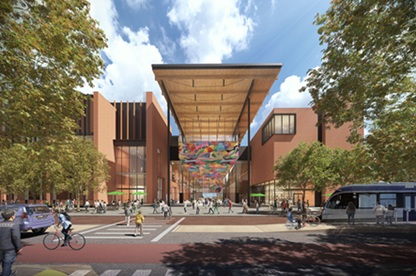 Once completed, the new Austin Convention Center will be the world’s first zero-carbon-certified convention center. The International Living Future Institute’s Zero Carbon Certification presents a bold vision for a future in which buildings are a positive force for climate response—helping to draw down emissions and slow global warming. This certification program tackles both operational and embodied carbon emissions, providing organizations with a powerful tool to showcase their commitment to sustainable practices. Zero Carbon certified buildings undergo a 12-month performance period and verification by a third party to ensure they are energy-efficient, combustion-free (or actively phasing out combustion), and powered by renewable sources.
Other project highlights include:
- Modern, flexible event spaces are designed to accommodate a wide range of gatherings while integrating natural light and open-air terraces.
- Expansive indoor-outdoor areas and pedestrian-friendly pathways to enhance connectivity with Waterloo Greenway and the Palm District.
- The smoke-free facility is cleaned with Green Seal certified products to limit harmful volatile organic compound (VOC) particulates in the air. The Integrated Pest Management system uses baits and traps and limits the use of chemicals. The City of Austin currently bans the use of Chlorpyrifos and Neonicotinoids at all facilities.
- Employs a LEED AP (accredited professional) and Master Electricians.
- Is an active Energy Star Partner with the United States Environmental Protection Agency and the U.S. Department of Energy.
- Networks with the International Facility Managers Association and International Association of Venue Managers and United States Green Building Council to stay educated in sustainable practices.
- Energy Conservation Energy upgrades have contributed 34 percent utility savings. Lighting changes have resulted in a 67 percent wattage reduction from 1,975,539 watts to 636,662 watts.
- During non-event hours, leased space and pre-function areas are conditioned at 85 degrees.
- Administrative areas are only conditioned Monday through Friday, 5 a.m. to 5 p.m.
- More than 90 percent of fixtures have been retrofitted with low water, hands-free devices.
- Intelligent irrigation system reduces waste.
- Only native and adaptive plant species are used in landscapes.
- The Department currently recycles the following items: paper, cardboard, metal, batteries, light bulbs and ballasts.
- Recycled carpet, with zero emissions, is installed throughout the facility.
- The Waste Management Team sorts and properly disposes of event waste.
- Windows, mirrors, floors (concrete and carpeted) and other hard surfaces are cleaned with electrolyzed water, which is generated on-site by the Orbio 5000-Sc, to replace standard cleaning chemicals. GreenSeal certified, UL Environment Environmental Choice certified, and EPA Comprehensive Procurement Guidelines approved chemicals are utilized for 60 percent of the remainder of the cleaning not handled by the Orbio system.
- New furnishings, such as elevator interiors, tables, seating and waste/compost/recycling containers, are sourced from manufacturers that utilize recycled aluminum.
- B-Cycle, a bike-sharing program and an alternative to carbon-emitting transportation, has two stations located at the Austin Convention Center. One station is at 499 E. 4th St. and the other is at 212 Trinity Street.
- Telecommute and 4/10 work schedules utilized throughout the year. • Light rail station is within 500 feet of the facility.
- Compliance officers educate management and staff about sustainable techniques. These teachings then not only become a regular part of facility operations but a habit of everyday life.
 The Austin Convention Center and Palmer Events Center are operated and managed by the Austin Convention Center Department (ACCD), a division of the City of Austin.
**See related news regarding the historic Trask house returning to its original site, a landmark moment in Austin Convention Center redevelopment.
For more information on the convention center construction, including renderings and project details, visit UnconventionalATX.com.