


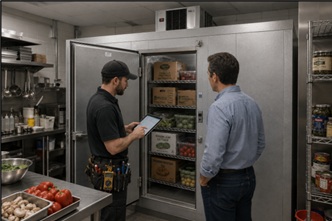
 NATIONAL REPORT—For many organizations, walk-in refrigeration is essential infrastructure. Restaurants rely on it to protect inventory. Healthcare facilities depend on it for temperature sensitive storage. Stadiums, commissaries, schools, and logistics operations need it to keep high volumes of product safe and available. Yet despite its importance, walk-in refrigeration is often evaluated through a narrow lens focused on upfront cost, footprint, and immediate cooling capacity.
That approach is beginning to shift. As environmental goals, energy costs, resilience planning, and reporting expectations become more prominent, owners are taking a broader view of building systems. Instead of asking only what a walk-in costs to purchase, more project teams are considering what it costs to operate, maintain, repair, and eventually replace. They are also paying closer attention to material durability, insulation performance over time, and how refrigeration decisions may be affected by changing regulations.
In that context, walk-in refrigeration becomes more than a standard equipment purchase. It becomes a long-term asset whose design decisions can influence energy use, lifecycle cost, and sustainability outcomes for years.
Moving Beyond Upfront Cost Toward Lifecycle Thinking
One of the biggest challenges in this segment is that walk-in refrigeration is not always evaluated with the same efficiency frameworks used for other commercial equipment categories. While some appliances benefit from widely recognized labels, incentives, or rebate programs, walk-ins are often purchased without those same signals. Unlike many reach-in cases, ice machines, or cooking appliances that may qualify for ENERGY STAR or utility rebates, walk-ins currently lack a widely adopted performance label, which makes it harder to steer buyers toward higher efficiency options even when they would support ESG goals and long-term savings.
That absence of simplified benchmarks can lead some buyers to assume that all walk-ins perform similarly. In practice, differences in construction quality, thermal integrity, and long-term durability can create substantial separation over the life of the system. Because refrigeration runs continuously, even modest inefficiencies can compound into higher utility bills, greater compressor wear, and more frequent service needs.
This is where lifecycle thinking becomes valuable. Owners increasingly want to understand not only what a system costs today, but what it will demand from the business over the next 10, 15, or 20 years. In sectors where margins are tight and uptime matters, durability and operating efficiency often become more important than small savings at the time of purchase.
Why Insulation Performance Matters to ESG Outcomes
Insulation is one of the most important contributors to walk-in performance, yet it is often overlooked because it is hidden inside the panel system. Strong insulation reduces heat transfer, helps maintain consistent interior temperatures, and lowers the workload placed on refrigeration equipment. Poor or degrading insulation gradually creates the opposite effect.
For efficiency-minded owners, long-term thermal performance matters more than an initial specification alone. If insulation loses effectiveness over time, compressors must cycle more often and consume more energy to hold the same conditions. Moisture intrusion can further reduce performance while contributing to premature deterioration. When comparing walk‑ins, specifiers can ask suppliers to document long-term R‑value performance, recycled content, and recyclability of the insulation system rather than relying only on a nameplate R‑value at day one.
Extruded polystyrene (XPS) insulation, distinct from expanded polystyrene (EPS) bead board with which it is sometimes mistakenly grouped, is engineered for strong moisture resistance and stable R‑value retention over extended periods. In many walk‑in applications, certain XPS panels incorporate recycled content and are designed to be 100 percent recyclable at end of life, which can help support embodied carbon and circularity targets alongside operational efficiency. By contrast, some foam‑in‑place polyurethane systems may start with high initial R‑values but are more prone to thermal drift and moisture absorption over time, especially if field conditions allow water intrusion into the panel.
Amerikooler’s DuPont XPS insulation is backed by a 50‑year R‑value warranty with no more than 10 percent degradation over that period, providing a level of long term performance assurance that is not commonly offered with foam‑in‑place polyurethane panels.
That distinction has real ESG implications. A walk-in that preserves thermal integrity for decades can reduce avoidable energy demand, place less strain on refrigeration equipment, and delay replacement cycles. It can also help organizations make stronger cases for total cost of ownership decisions rather than defaulting to the lowest first cost.
Real Sustainability Depends on Installation & Daily Use
Even high-quality equipment can fail to deliver expected results when installation or operation is inconsistent. Real world performance often depends on details that are easy to overlook during construction or day to day use. Several recurring field issues can undermine walk-in performance, including improperly sealed penetrations for piping or wiring, gaps caused by poor panel assembly, blocked evaporator airflow, doors left open during deliveries, and overloaded interiors that restrict air circulation. In some foam‑in‑place panel systems, installers may also encounter voids where spray foam did not fully fill the cavity, which can show up later as localized “sweat spots” in the middle of a panel and require on‑site drilling and patching. Over years of service, moisture absorption inside certain panel types can also create telltale rust lines along the base, signaling hidden water accumulation that undermines both thermal performance and long-term durability. Because that absorbed moisture can mingle with food residues if the metal skin is breached, panel construction and moisture resistance have implications not just for energy use but also for sanitation and food safety. These problems can lead to temperature swings, condensation, icing, higher energy consumption, and unnecessary wear on refrigeration systems.
On the operations side, simple habits—such as leaving doors propped open during deliveries, removing strip curtains that staff find inconvenient, or stacking product directly in front of the evaporator—can have the same effect as downsizing the insulation or refrigeration system on paper. Many industry food safety guidelines already call for air curtains or strip curtains at walk-in entrances, and some operators are now turning to vinyl swing doors to maintain airflow separation without creating an obstacle for staff.
For these reasons, ESG performance should not be treated as something designed only at the factory. It must also be supported through commissioning, staff training, and operating discipline. A properly installed walk-in with clear airflow paths and consistent door management can perform very differently from an identical unit that is misused or poorly maintained. Organizations that want measurable results should view training and maintenance as part of the sustainability strategy. In many facilities, behavior change can unlock efficiency gains just as effectively as equipment upgrades.
Refrigerant Transitions & Future Proof Specifications
Refrigerant choice has become a more strategic issue as regulations evolve and lower-GWP alternatives enter the market. Newer lower‑GWP A2L refrigerants can support environmental goals, but they often introduce design considerations related to leak detection, ventilation, equipment placement, service familiarity, and jurisdiction‑specific code requirements, and they typically carry both higher equipment costs and added installation work compared with many legacy A1 blends.
That means refrigerants should be evaluated as part of a larger system decision rather than as a single line item. A product that looks attractive on paper may create challenges if local regulations differ, if technicians are not yet trained to support it, or if equipment locations must be redesigned to meet compliance needs. Likewise, a short-term cost saving decision can create retrofit pressure later if standards continue to tighten. Some owners are still operating or specifying older A1 refrigerants in applications where federal rules now point to A2L systems, with enforcement varying by state and even by local jurisdiction, which creates a risk of non‑compliant systems that may be expensive to rework once oversight catches up.
Future-ready specifications balance environmental progress with practical execution. Owners and consultants who evaluate local code conditions, likely regulatory direction, service support availability, and total installation requirements are generally better positioned than those who focus only on refrigerant labels. Looking ahead to potential wider adoption of trans critical CO₂ systems and other alternatives, design teams will also need to consider technician training, higher operating pressures, and climate‑specific performance when deciding how “future ready” a given specification truly is. In a rapidly changing environment, flexibility can be as valuable as efficiency.
Documentation, Circularity, & the Next Standard for Procurement
Many ESG frameworks now extend beyond operational energy use to include embodied carbon, recycled material content, reuse potential, and end of life planning. Walk-in refrigeration is increasingly part of that conversation, particularly as owners recognize that cold storage systems can remain in service for decades and influence both operating efficiency and replacement cycles over time. On the manufacturing side, some panel systems now use insulation that incorporates recycled content and can be fully recycled at end of life, with production scrap shredded, baled, and diverted from landfill into reuse streams rather than discarded as waste.
These priorities reflect a broader shift in procurement. Buyers increasingly want documentation that can withstand internal review, consultant scrutiny, or external reporting requirements. Warranty terms, thermal data, code certifications, recycled content records, sanitation considerations, and service expectations are becoming more relevant during specification rather than after installation. Much of this information can be supported with third‑party documentation from material suppliers—such as long-term R‑value warranties, embodied carbon summaries, and recycled content declarations for insulation—which makes it easier for owners to substantiate ESG claims in formal reporting. Just as important, many projects now require more detailed planning around site conditions, floor level, jurisdictional codes, refrigeration placement, and long-term maintenance access before equipment is ordered.
This is where experienced manufacturers can create value beyond fabrication alone. Amerikooler, a long-established manufacturer of walk-in coolers and freezers, has built its reputation not only on producing custom cold storage systems, but on helping customers navigate the practical realities that determine long term success. That includes guiding buyers toward appropriate panel construction, interpreting regional code requirements, and helping customers avoid short-term decisions that may lead to higher lifecycle costs later.
Amerikooler also emphasizes durability and circularity through recyclable insulation materials, long-term thermal performance, and the potential for certain systems to be reused or repurposed when facilities change hands or operations evolve. Combined with responsive project support and custom engineered solutions across foodservice, healthcare, institutional, and large-spec environments, that positions the company as more than a supplier, it positions Amerikooler as a consultative partner in sustainable cold storage planning.
As ESG standards continue to mature, that type of expertise will only grow in importance. The strongest refrigeration investments will not simply be the cheapest units to buy, but the systems backed by sound engineering, clear documentation, trusted guidance, and performance that holds up for years.
Peter Vizcon is Director of Outside Sales at Amerikooler.